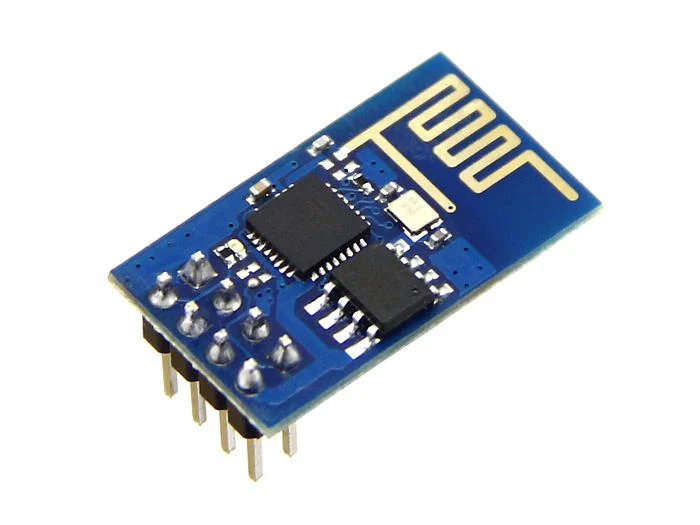
ESP8266 ESP-01
Category: ESP Module
₦5000.00
The ESP8266 ESP-01 is a compact and low-cost Wi-Fi module designed for basic IoT, wireless communication, and internet-enabled electronics projects.
Key Features
Based on ESP8266EX microcontroller
Built-in 2.4 GHz Wi-Fi (802.11 b/g/n)
Extremely compact and lightweight design
Supports TCP/IP networking stack
UART serial communication interface
Low power consumption with sleep modes
Supports AT commands and Arduino IDE programming
Ideal for simple Wi-Fi connectivity tasks
Detailed Description
The ESP8266 ESP-01 is one of the earliest and most widely used Wi-Fi modules in the ESP8266 family. Its small size and affordability make it an excellent choice for projects that require basic wireless connectivity without many input/output pins.
The module integrates a full TCP/IP stack, allowing it to connect directly to the internet and communicate with cloud servers or local networks. It can be used as a standalone microcontroller for simple applications or as a Wi-Fi adapter controlled by another microcontroller such as an Arduino.
Due to its limited number of GPIO pins, the ESP-01 is best suited for straightforward IoT tasks such as wireless switching, remote control, and data transmission. Programming can be done using AT command firmware or custom firmware through the Arduino IDE with the help of an external USB-to-TTL converter.
Technical Specifications
Microcontroller: ESP8266EX
Operating Voltage: 3.3V
Wi-Fi Standard: 802.11 b/g/n (2.4 GHz)
Flash Memory: 1 MB
SRAM: 160 KB
Clock Speed: 80 MHz
GPIO Pins: 2 usable GPIOs
Antenna: On-board PCB antenna
Interface: UART
USB Interface: Not onboard
What’s in the Box
1 × ESP8266 ESP-01 Wi-Fi Module
Ideal For
Basic IoT and Wi-Fi projects
Wireless switch and relay control
Simple sensor data transmission
Smart home starter projects
Learning Wi-Fi communication basics
Important Note
The ESP8266 ESP-01 operates at 3.3V only and is not 5V tolerant. A stable 3.3V power supply is required, as insufficient current can cause connection issues. Programming requires an external USB-to-TTL converter, and GPIO availability is limited.