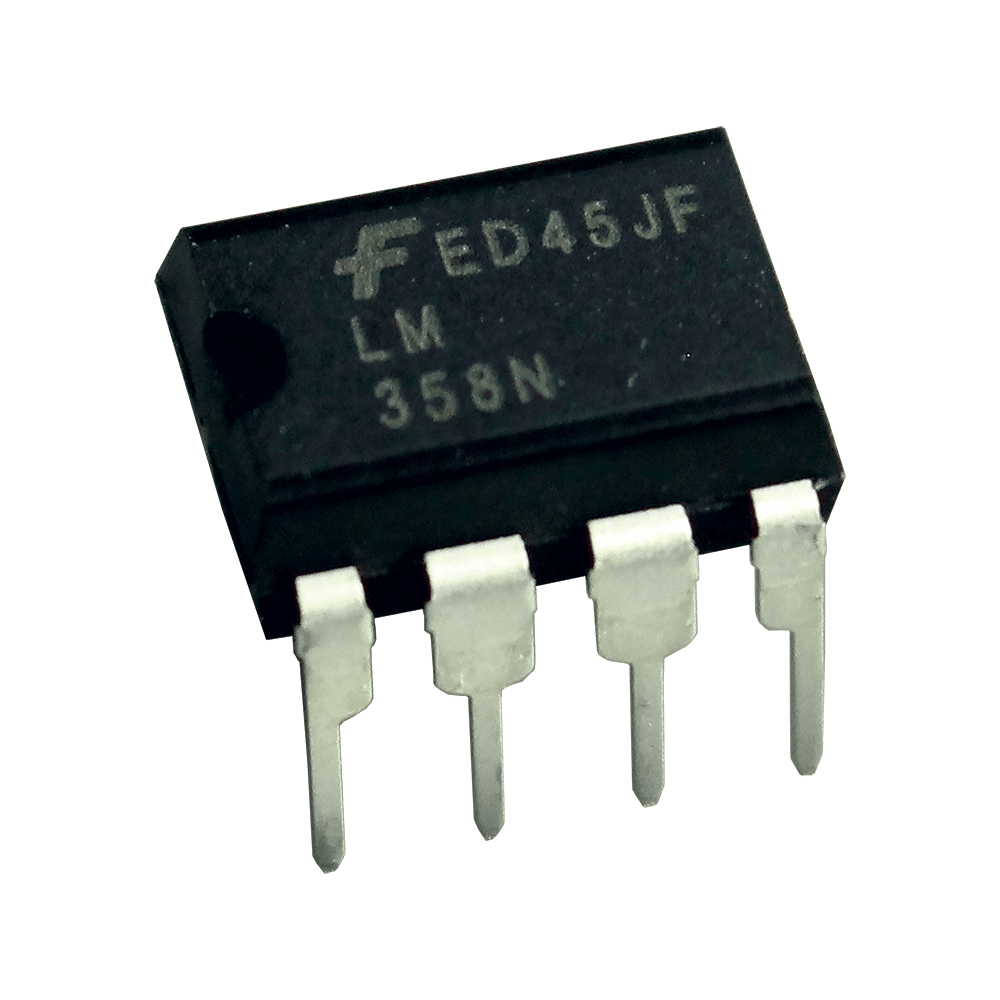
Op-Amp LM358
Category: ICs
₦450.00
The LM358 is a dual operational amplifier IC designed for low-power, single-supply applications, making it ideal for signal conditioning, amplification, and analog electronics projects.
Key Features
Dual operational amplifiers in a single IC
Operates from a single power supply
Low power consumption
Wide input voltage range
Output voltage swing includes ground
High gain and stable performance
Compatible with a wide range of analog circuits
Detailed Description
The LM358 operational amplifier is a versatile and widely used analog IC containing two independent, high-gain op-amps in one package. It is specifically designed to operate from a single power supply, which makes it very suitable for battery-powered and microcontroller-based systems.
Unlike many traditional op-amps, the LM358 allows its input voltage range to include ground, enabling easy interfacing with sensors and low-level analog signals. It is commonly used for signal amplification, voltage comparison, active filters, oscillators, and sensor signal conditioning.
Due to its low power consumption and reliable performance, the LM358 is frequently used in Arduino projects, power monitoring circuits, audio processing (non-hi-fi), and industrial electronics. It is easy to use for both beginners and professionals.
Technical Specifications
IC Type: Dual Operational Amplifier
Model: LM358
Supply Voltage Range: 3V – 32V (single supply)
Dual Supply Range: ±1.5V to ±16V
Input Offset Voltage: ~2 mV
Gain Bandwidth Product: 1 MHz
Slew Rate: 0.3 V/µs
Package Type: DIP-8 / SOIC-8
Operating Temperature: 0°C to 70°C
What’s in the Box
1 × LM358 Operational Amplifier IC
Ideal For
Signal amplification and conditioning
Sensor interfacing circuits
Voltage comparators
Active filters and oscillators
Arduino and analog electronics projects
Important Note
The LM358 is not a rail-to-rail output op-amp. The output voltage cannot reach the positive supply rail. For applications requiring rail-to-rail performance, consider alternative op-amp models.