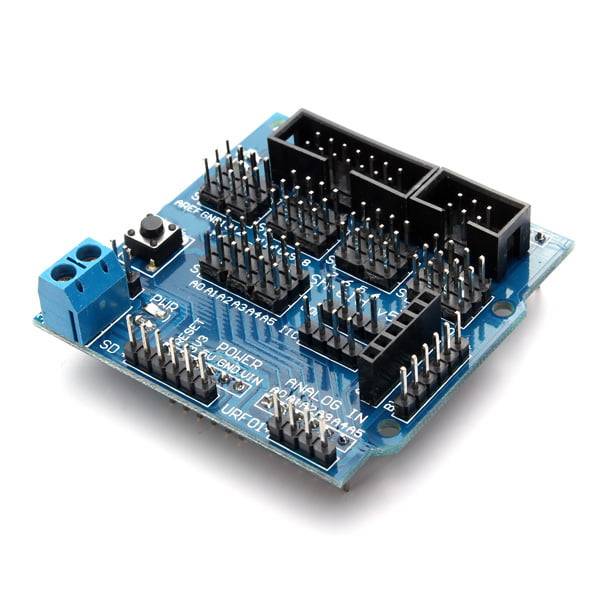
Sensor Shield
Category: shield
₦3500.00
The Arduino Sensor Shield is an expansion board designed to simplify connecting multiple sensors and modules to Arduino boards, providing a plug-and-play interface for rapid prototyping and electronics projects.
Key Features
Compatible with Arduino UNO, Mega, and Nano (via adapter)
Provides multiple sensor connectors for analog, digital, and power pins
Stackable design allows use with other Arduino shields
Includes GND, 5V, and 3.3V power lines for sensor operation
Standardized pin headers for easy connection to sensors, servos, and modules
Ideal for IoT, robotics, and data acquisition projects
Supports Arduino IDE and standard libraries
Detailed Description
The Arduino Sensor Shield is designed for makers, students, and hobbyists to quickly and efficiently connect multiple sensors to an Arduino board. It eliminates the need for complex breadboard wiring and jumper cables, providing direct plug-and-play connections for analog and digital sensors, servos, and other modules.
With power rails for 5V, 3.3V, and GND, the shield ensures reliable sensor operation and simplifies circuit design. Its stackable design allows you to combine it with other shields like motor drivers, display shields, or relay shields, enabling more complex projects without wiring conflicts.
This shield is perfect for educational projects, IoT experiments, robotics, environmental monitoring, and DIY electronics prototyping. It helps beginners and professionals alike reduce setup time while maintaining a clean and organized circuit layout.
Technical Specifications
Shield Type: Sensor Expansion Shield
Compatible Boards: Arduino UNO, Mega, Nano (via adapter)
Power Rails: 3.3V, 5V, and GND
I/O Breakouts: Digital, Analog, and PWM pins accessible
Interface: Direct Arduino pin headers
Mounting: Stackable Arduino shield
Operating Voltage: 5V DC
What’s in the Box
1 × Arduino Sensor Shield
1 × User guide / documentation (optional)
Ideal For
Connecting multiple analog and digital sensors to Arduino
Robotics and IoT projects
Data acquisition and monitoring systems
Educational electronics labs and DIY projects
Rapid prototyping and experimentation
Important Note
Ensure proper voltage levels when connecting sensors to the shield. Some sensors require 3.3V, while others require 5V. Always follow the correct pin mapping and polarity to prevent damage.