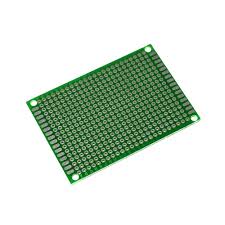
Prototype PCB Board
Category: General
₦800.00
The Prototype PCB Board is a versatile and durable printed circuit board designed for soldering components and creating custom electronic circuits for prototyping and DIY projects.
Key Features
Made from high-quality FR-4 material for durability and heat resistance
Standard through-hole design for easy soldering of components
Compatible with resistors, capacitors, ICs, LEDs, and other modules
Multiple sizes available for different project requirements
Ideal for Arduino, Raspberry Pi, and other microcontroller projects
Lightweight, compact, and easy to cut or drill for custom layouts
Suitable for DIY electronics, robotics, and educational experiments
Detailed Description
The Prototype PCB Board is a must-have for electronics hobbyists, students, and professionals who want to build and test circuits without designing a custom PCB. Its pre-drilled holes and standard grid layout allow for easy soldering of discrete components, ICs, sensors, and modules.
This board is widely used in Arduino and Raspberry Pi projects, robotics, IoT prototypes, LED circuits, and small electronic devices. Its durable FR-4 material ensures stable operation even under heat from soldering.
The Prototype PCB Board enables quick experimentation, allowing users to develop and test circuits efficiently before creating permanent designs. Its versatility makes it ideal for educational labs, DIY kits, and professional electronics prototyping.
Technical Specifications
Type: Prototype / Perf PCB Board
Material: FR-4 (fiberglass epoxy)
Hole Pitch: 2.54mm (standard)
Board Sizes: Various (e.g., 5×7cm, 7×9cm, 10×15cm)
Hole Diameter: ~1mm
Copper Layer: Single-sided or double-sided (varies by variant)
Mounting: Solderable components
Operating Temperature: -40°C – 120°C
What’s in the Box
1 × Prototype PCB Board (size and variant as selected)
Ideal For
DIY electronics projects and prototyping
Arduino, Raspberry Pi, and microcontroller experiments
Robotics, sensor circuits, and LED projects
Educational electronics labs and training kits
Hobbyists and professional electronics development
Important Note
Always solder components carefully to avoid damaging the PCB. Ensure proper voltage and polarity connections in your circuits. Boards can be cut or drilled for custom layouts if needed.