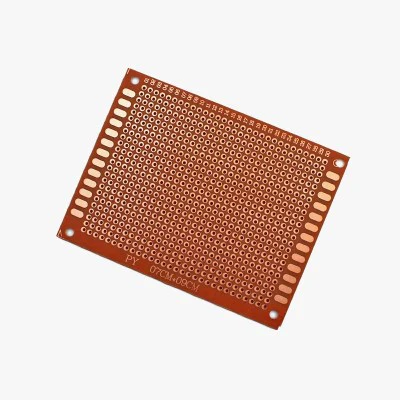
Zero PCB Board
Category: General
₦1000.00
The Zero PCB Board is a versatile printed circuit board designed for rapid prototyping of electronic circuits. It allows hobbyists, students, and engineers to create custom designs without designing a full custom PCB.
Key Features
Made from high-quality FR-4 material for durability and heat resistance
Standard through-hole grid layout for easy soldering of components
Compatible with resistors, capacitors, ICs, sensors, LEDs, and modules
Multiple sizes and hole configurations for flexible circuit design
Compact, lightweight, and easy to mount or modify
Ideal for Arduino, Raspberry Pi, and microcontroller-based projects
Suitable for DIY electronics, robotics, and educational experiments
Detailed Description
The Zero PCB Board provides a convenient platform for building and testing circuits without committing to a permanent PCB design. Its pre-drilled holes and uniform grid layout make it easy to solder standard electronic components and create stable connections.
It is commonly used for Arduino and Raspberry Pi projects, robotics, IoT prototypes, LED circuits, and other electronics experiments. Its durable FR-4 material ensures stability even when soldering multiple components.
The Zero PCB Board is perfect for educational labs, DIY electronics kits, and hobbyist projects, allowing for easy adjustments and modifications during prototyping.
Technical Specifications
Type: Zero Prototype PCB Board
Material: FR-4 (fiberglass epoxy)
Hole Pitch: 2.54mm (standard)
Board Sizes: Various (e.g., 5×7cm, 7×9cm, 10×15cm)
Hole Diameter: ~1mm
Copper Layer: Single-sided or double-sided (depending on variant)
Mounting: Solderable components
Operating Temperature: -40°C – 120°C
What’s in the Box
1 × Zero PCB Board (size and variant as selected)
Ideal For
DIY electronics prototyping and experimentation
Arduino, Raspberry Pi, and microcontroller projects
Robotics, LED, and sensor circuits
Educational electronics labs and training kits
Hobbyist and professional electronics development
Important Note
Always solder components carefully to prevent damage to the PCB. Ensure proper voltage and polarity connections in your circuits. Boards can be cut or drilled for custom layouts if needed.