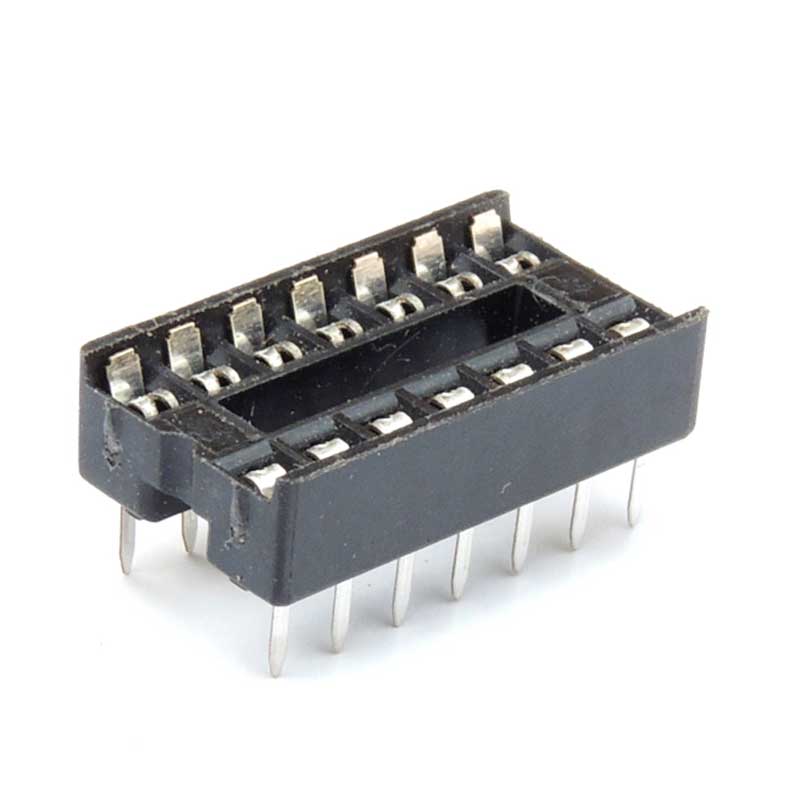
IC Socket
Category: General
₦1000.00
The IC Socket is a small but essential component used to securely mount integrated circuits (ICs) onto a PCB, allowing for easy installation, replacement, and protection of sensitive ICs.
Key Features
Provides safe and reliable IC connections without soldering the IC directly
Compatible with DIP (Dual Inline Package) ICs of various pin counts
Protects ICs from heat damage during soldering
Easy to insert and remove ICs for testing or replacement
Durable plastic housing with metal contacts for stable conductivity
Ideal for Arduino, Raspberry Pi, microcontroller, and DIY electronics projects
Saves time and effort during prototyping and maintenance
Detailed Description
The IC Socket is an essential tool for electronics enthusiasts, students, and professionals. By mounting an IC in a socket rather than soldering it directly, you protect sensitive chips from heat and allow for easy replacement or upgrades.
IC sockets are widely used in prototyping, Arduino and microcontroller circuits, robotics, sensor modules, and other DIY electronics projects. They are especially helpful when testing multiple ICs or designing circuits where IC replacement may be required.
With a reliable metal contact inside the socket, it ensures stable electrical connections while preventing wear or damage to the IC pins. The plastic housing is durable and heat-resistant, making it ideal for repeated use in labs and workshops.
Technical Specifications
Type: IC Socket
Compatible ICs: DIP (Dual Inline Package)
Number of Pins: Various (e.g., 8, 14, 16, 20, 28 pins)
Material: Plastic housing with metal contacts
Mounting Type: Through-hole PCB
Operating Temperature: -40°C – 105°C
Dimensions: Standard DIP footprint for corresponding IC
What’s in the Box
1 × IC Socket (pin count as selected)
Ideal For
Arduino and microcontroller circuits
DIY electronics and prototyping
Robotics and sensor modules
Educational electronics kits and labs
Testing and replacing ICs without soldering
Important Note
Ensure that the IC pins match the socket pin count before insertion. Insert ICs carefully to avoid bending pins. Avoid exceeding the recommended voltage and current for the IC used in the socket.